Changzhou Treering Plastics Co., ltd
Quality is our Culture
Profession Manufacture of rotomoulding products and industrial plastic products ( Serena@cztreering.com )
Changzhou Treering Plastics Co., ltd
Quality is our Culture
Profession Manufacture of rotomoulding products and industrial plastic products ( Serena@cztreering.com )
 |
| Place of Origin: | Changzhou Jiangsu China |
| Brand Name: | Treering |
| Certification: | ISO 9001 |
| Model Number: | Nl-Custom rotomolded utility vehicle body |
| Minimum Order Quantity: | Negotiation |
|---|---|
| Price: | Negotiation |
| Packaging Details: | Plastic warp / Carton /Pallet |
| Delivery Time: | 3-20 days |
| Payment Terms: | T/T, L/C, D/A, D/P, Western Union, |
| Supply Ability: | 50 pcs per weeks |
| Color: | Customizable | Impact Resistance: | High |
|---|---|---|---|
| Uv Stabilised: | Yes | Design Flexibility: | High |
| Feture: | Durable ,UV Stabilised | Drain Fitting Size: | 1/2 , 1" , 1.5" Or More |
| Eco-Friendly: | Yes | Manufacturing Material: | LLDPE |
A Custom Utility Vehicle Body Project — Where Product Geometry Meets Real-World Assembly
A custom plastic body for a utility vehicle is rarely just a cover.
It may need to create space for mechanical components, provide a cargo compartment, accommodate mounting hardware, and connect
with other parts of the equipment.
These functions must coexist within a limited physical space.
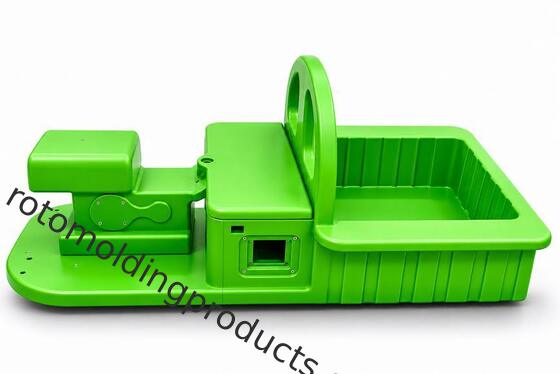
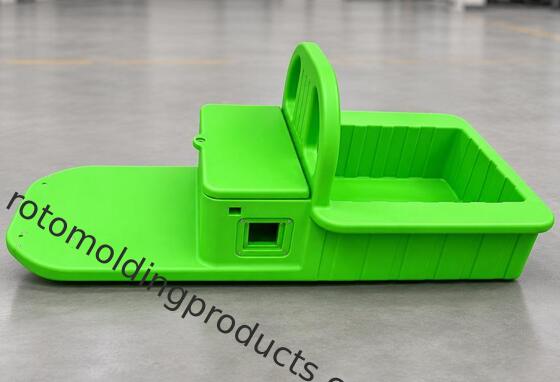
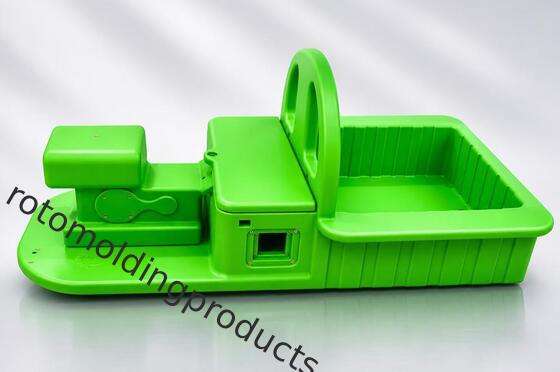
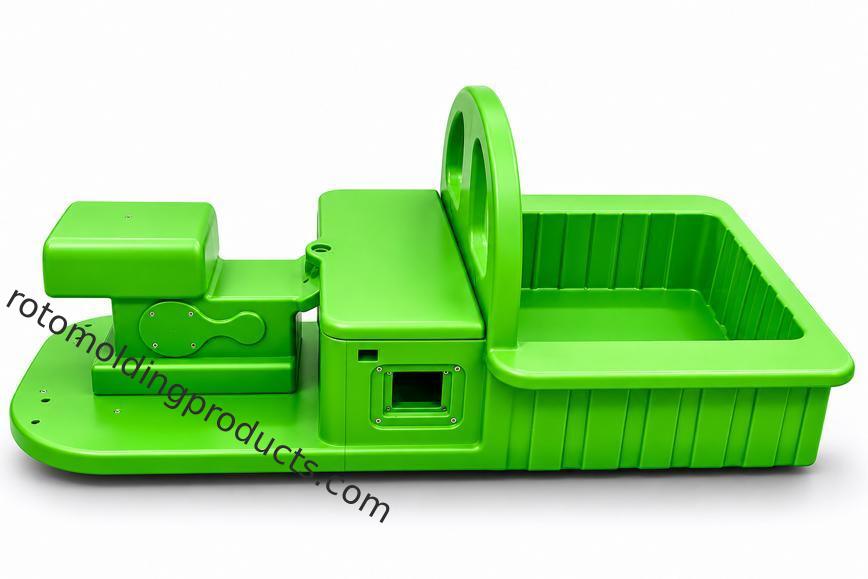
The green molded structure shown in this project provides a practical example.
At one end, a flat platform accommodates raised and recessed features. The central section incorporates a covered housing, a rectangular
interface opening, and a curved upright partition. At the opposite end, an open cargo compartment includes ribbed sidewalls and a wide
rounded rim.
Each section has a different geometric requirement.
Together, they form an application-specific plastic body configuration.
For Changzhou Treering Plastics Co., Ltd., projects like this illustrate an important principle of custom rotational molding:
A successful plastic component must be designed around what it needs to do, not simply what it needs to look like.
The visible structure combines several features that are often treated as separate considerations in product development.
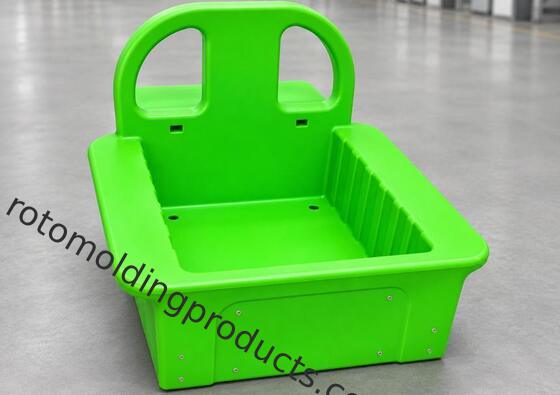
The open cargo section is a prominent feature of this product.
It has a deep recessed interior, a broad upper rim, and molded vertical ribs along the sidewalls.
These features show how the cargo area has been incorporated into the overall plastic body design rather than presented as a
conventional rectangular storage box.
The design raises several important manufacturing questions:
How should the corners transition between the sidewalls and the bottom?
What wall thickness is appropriate for the intended application?
How should the rim be formed to meet the dimensional and functional requirements?
How will the molded compartment connect with the rest of the equipment?
Answers depend on the customer's expected use, the selected material, the part geometry, and the necessary validation.
A distinctive upright partition separates the cargo area from the central section.
Its upper portion incorporates two large rounded openings, while smaller rectangular openings are visible below.
These details are important because openings change the geometry of the molded structure.
They can affect tooling decisions, trimming requirements, dimensional inspection, and the way the component interacts with other parts.
When evaluating similar designs, we consider how the openings will be produced and whether their location and finish can meet the customer's requirements.
The objective is to retain necessary functional features while developing a practical manufacturing approach.
The central structure includes a covered upper surface and a rectangular side opening with visible fastener positions.
This arrangement demonstrates how equipment interfaces can influence the shape of a custom molded component.
The opening may need to accommodate a customer-specified fitting, access feature, or additional assembly.
For an OEM project, the surrounding dimensions are often as important as the opening itself.
Insufficient clearance, poorly positioned fasteners, or an unsuitable mounting surface can create complications during assembly.
For this reason, we encourage customers to provide the dimensional requirements of connecting components during design review.
The opposite end of the structure includes a broad platform and raised features.
Its rounded perimeter, molded surfaces, and mounting positions demonstrate the geometric flexibility that may be required in customized equipment components.
A platform is not necessarily a simple flat surface.
It may need to accommodate different part heights, attachment locations, assembly clearances, or adjacent equipment.
These relationships should be reviewed before the tooling design is finalized.

Our manufacturing capabilities include:
OEM & ODM plastic component manufacturing
Custom vehicle body panels and cargo compartments
Heavy-duty LLDPE rotational molding
Complex hollow and irregular-shaped components
Custom colors, wall thicknesses, and mounting features
Prototype development and production tooling
Factory-direct manufacturing and export support
| Item | Custom Manufacturing Options |
|---|---|
| Product Category | Rotomolded Vehicle Body & Cargo Components |
| Manufacturing Process | Rotational Molding |
| Standard Material | Virgin LLDPE |
| Alternative Materials | Application-dependent, subject to technical evaluation |
| Product Dimensions | Customized according to approved drawings |
| Wall Thickness | Designed according to loading and structural requirements |
| Maximum Equipment Capacity | Rotomolding machine up to 7.5 m |
| Large Component Capability | Selected parts up to approximately 7 m, subject to geometry and tooling review |
| Colors | Black, white, gray, yellow, blue, and custom colors |
| Surface Finish | Smooth or textured, depending on mold design |
| Product Structure | Hollow, single-piece or assembled component designs |
| Mounting Features | Custom holes, inserts, brackets and fixing points |
| UV Resistance | UV-stabilized material options available upon request |
| Tooling | Custom mold development |
| Design Input | 2D drawings, 3D CAD files, or physical samples |
| MOQ | Determined by product size and tooling requirements |
| Quality Control | Dimensional, visual and wall-thickness inspection as applicable |
| Applications | Utility Vehicles, Specialty Vehicles, Cargo Equipment and Industrial Machinery |
| Manufacturer | Changzhou Treering Plastics Co., Ltd. |
| Country of Origin | China |
All dimensions, tolerances, material grades, structural performance and other technical parameters are subject to project-specific engineering confirmation.
A CAD model can display nearly any shape.
A production mold must work within real manufacturing constraints.
That difference becomes especially important for complex rotomolded plastic components.
Consider a design containing deep recesses, curved partitions, mounting holes, and a cargo compartment.
Each feature may be individually achievable, but their combination can influence the manufacturing approach.
During a custom project review, important considerations include:
Mold accessibility
Can the required geometry be formed and removed from the tooling without compromising critical features?
Material distribution
How might the geometry influence wall formation, especially near corners, transitions, and recessed areas?
Secondary operations
Which openings or interfaces may require trimming, drilling, or other finishing processes?
Dimensional requirements
Which surfaces and mounting points require special attention during sample inspection?
Assembly compatibility
Will the molded component fit the surrounding equipment as intended?
These questions help determine whether the design is practical before committing to production tooling.
Wall thickness is one of the first specifications requested in many rotational molding projects.
However, a thickness figure cannot fully describe the behavior of a complex plastic body.
A ribbed sidewall, an unsupported flat section, a corner transition, and a mounting area may respond differently to the same operating conditions.
The intended application must therefore guide the design review.
For example, the ribbed walls visible in this cargo compartment provide a different geometry from its relatively flat bottom.
The upright partition introduces another set of geometric considerations.
The central interface opening creates a localized area where dimensional requirements and attachment details may be important.
For similar products, we can discuss material grade, nominal wall thickness, local geometry, and manufacturing feasibility according to the
customer's specifications.
Where a customer requires verified strength, impact resistance, load capacity, or other mechanical performance, an appropriate test and
acceptance plan should be established.
We believe technical decisions should be based on the application's requirements rather than unsupported performance claims.
Rotational molding is a manufacturing process particularly suited to many hollow and complex-shaped thermoplastic components.
Unlike manufacturing methods that depend on high-pressure injection into a mold cavity, rotational molding uses controlled heating and
rotation to distribute material inside a mold.
For certain custom equipment components, the process offers useful design possibilities.
These can include hollow sections, generous corner radii, molded recesses, and relatively large three-dimensional forms.
However, rotational molding also involves design limitations.
Extremely tight tolerances, certain internal geometries, and features that prevent demolding may require design changes or secondary
operations.
The important question is not whether rotational molding can create a complicated shape.
It is whether the process can create the required shape consistently, at an acceptable total manufacturing cost.
At Treering, we evaluate custom projects with this practical objective in mind.
Tooling cost and unit price are important, but they are not the only factors affecting an OEM project.
A component that requires extensive modification after molding may become expensive during regular production.
The same is true when a design creates assembly difficulties or requires repeated dimensional adjustments.
Early manufacturing review helps customers identify these risks.
For example:
A mounting opening may be straightforward to produce, but its location must be correct relative to the surrounding assembly.
A wide cargo rim may look attractive, but its geometry must also be suitable for tooling and production.
A recessed area may provide space for another component, but additional processing could be necessary to achieve the final interface.
These examples explain why manufacturing feasibility should be considered together with the design.
We aim to help customers make these decisions before avoidable costs are built into the project.
We do not approach every OEM project with a fixed product configuration.
Customers may require different dimensions, mounting positions, cargo geometry, surface features, material properties, or production
volumes.
Our first step is to understand which requirements are essential.
For a project involving a custom utility vehicle body, we would normally discuss:
Overall dimensions and available installation space
Intended operating conditions
Cargo compartment geometry and expected loading requirements
Mechanical and electrical interface locations
Mounting holes and assembly clearances
Material requirements and target wall thickness
Surface finish and color preferences
Expected order quantity
Tooling budget and production schedule
Required inspections and performance validation
These details provide the basis for a meaningful manufacturing assessment.
Not every requested feature can be incorporated without compromise.
Where necessary, we discuss alternatives that preserve the customer's functional objectives while improving manufacturing practicality.
Changzhou Treering Plastics Co., Ltd. is a custom rotational molding manufacturer based in Changzhou, Jiangsu Province, China.
We work directly with overseas customers on OEM and ODM plastic manufacturing projects, from reviewing product requirements and
developing custom tooling to sampling and production.
Our manufacturing focus includes complex hollow plastic structures, industrial containers, equipment components, and application-specific
molded products.
When you contact Treering, you are communicating with the manufacturing team responsible for evaluating and producing your custom
plastic components.
A direct manufacturing partner in China — focused on making your custom design practical to produce.
The project begins with customer requirements, drawings, samples, or an initial product concept.
We review the intended application and identify the information needed for a manufacturing assessment.
The design is examined for tooling feasibility, component interfaces, hollow sections, openings, wall thickness considerations, and finishing requirements.
Material selection, tooling construction, sample expectations, and production requirements are discussed with the customer.
Initial molded samples provide an opportunity to evaluate appearance, dimensions, and the agreed functional requirements.
Any necessary changes can be reviewed before production approval.
Following approval, production is arranged according to the confirmed specifications and agreed quality requirements.
Inspection priorities may include dimensions, appearance, openings, and other customer-defined characteristics.
Products are packaged and shipped according to the agreed order and logistics requirements.
The objective is to develop a manufacturing process that is practical beyond the first acceptable sample.
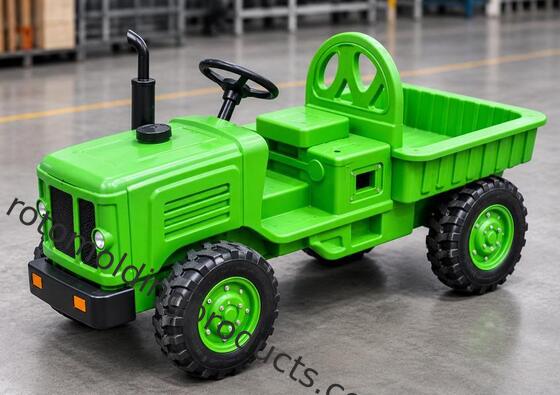
This particular project involves a utility vehicle body and cargo structure.
However, the manufacturing questions it raises also appear in many unrelated industries.
Similar design considerations may arise in:
Agricultural equipment: custom plastic covers, tanks, and equipment housings.
Industrial machinery: specialized enclosures, hollow protective structures, and functional components.
Material handling: custom containers, carts, and equipment bodies.
Special-purpose vehicles: plastic cargo compartments, body panels, and application-specific structures.
Industrial OEM products: complex hollow parts designed around equipment interfaces and customer specifications.
These are potential application areas rather than interchangeable standard products.
Every new design requires its own assessment.
Yes. We can review customer drawings and 3D models to evaluate the geometry, tooling requirements, and rotational molding feasibility.
Yes, depending on the design. Some features may be incorporated into the tooling, while others may require secondary processing. Their dimensions and locations should be confirmed during the design review.
We can evaluate different compartment dimensions, shapes, wall configurations, and related features for new OEM projects. Changes may require new or modified tooling.
Rotational molding can manufacture suitable plastic components used in a vehicle or equipment assembly. Mechanical systems, wheels, steering assemblies, and other non-molded components are separate considerations.
We work with rotational molding polyethylene materials, including LLDPE. The exact grade should be selected according to the application, operating environment, and required properties.
Load capacity cannot be established from appearance or wall thickness alone. It depends on the complete product design and operating conditions. Specific performance requirements should be supported by an agreed validation method.
Not necessarily. A dimensioned drawing, 3D model, or sufficiently detailed product concept can provide a starting point for discussion.
We support custom mold development and sample production according to the project's agreed technical and commercial requirements.
A custom plastic body is more than a collection of surfaces.
Its compartments, openings, structural geometry, and mounting features all need to work together within a real application.
That is why we prefer to understand the complete problem before discussing the mold.
At Changzhou Treering Plastics Co., Ltd., we help customers evaluate custom rotational molding projects from product requirements
through tooling and manufacturing.
Whether your project involves a utility vehicle, industrial equipment, or a completely different plastic structure, we welcome the opportunity
to discuss its feasibility.
Send us your 3D model, technical drawing, physical sample, or application requirements.
Let's begin with what the product needs to accomplish.
Changzhou Treering Plastics Co., Ltd.
Custom Rotational Molding | OEM & ODM Manufacturing
Website: www.cztreering.com
Email: Serena@cztreering.com
Request a Custom Rotomolding Quote
Contact Person: Ms. Serena Tao
Tel: +8615051955023 (Wechat)